
Are old windows thicker at the bottom because glass flows?
The short answer
Panes in very old windows are often thicker at the bottom, and a popular explanation says glass slowly flows. We looked at the physics of glass and at how old panes were made and fitted.
Verdict: False. Old window panes are often thicker at the bottom, but not because the glass has been slowly running downhill for centuries. At room temperature, window glass is rigid for all practical purposes. The uneven thickness was built in when the glass was made, and glaziers usually put the heavy edge at the bottom.
It is one of the most repeated "facts" in science classrooms, and it sounds like a good one. Glass has no neat crystal structure, it does soften gradually when heated instead of melting at one sharp temperature, and the evidence seems to be sitting right there in the windows of old churches. So it is worth taking the claim seriously before taking it apart.
Where the idea comes from
The claim has two parts. The first is about what glass is. Scientists describe glass as an amorphous solid: its atoms sit in a disordered arrangement, much like the atoms in a liquid, rather than in the repeating lattice of a crystal such as quartz. Because of that resemblance, glass has long been described as a "supercooled liquid", a liquid that cooled so fast it never got the chance to crystallise.
The second part is the window evidence. If glass is "really" a liquid, the reasoning goes, then given enough time it must flow, and the thick bottoms of old panes show it happening.
Teachers and textbooks spread the second part. In a 1989 paper in the Journal of Chemical Education, "Antique windowpanes and the flow of supercooled liquids", the chemist Robert C. Plumb noted that many students and teachers believed exactly this, and that textbooks had used old windows as an illustration of glass flowing. Plumb's paper was written to correct it.
How slowly would glass have to flow?
The most direct test is a calculation. In 1998 the materials scientist Edgar Dutra Zanotto published a short paper in the American Journal of Physics with the title "Do cathedral glasses flow?". He took measured viscosities for glasses of the kind used in medieval windows and asked how long it would take for them to sag noticeably at ordinary temperatures.
The answer was nowhere near a few hundred years. His estimate for visible flow at room temperature was far longer than the age of the universe, which is about 13.8 billion years. As Science put it when it reported the paper, the cathedral glass myth was shattered. Zanotto and P. K. Gupta followed up in the same journal in 1999 with further remarks that came to the same conclusion.
The reason is viscosity. Glass at room temperature is so viscous that any flow is far too small to see over human history, let alone to pile up millimetres of extra glass at the bottom of a pane. For visible flow you need heat, which is why glassblowers work it in a furnace and not on a windowsill.
So why are old panes thicker at one edge?
Because of how flat glass was made before modern methods. Two traditional techniques produced most window glass in Europe.
In the crown process, a glassmaker spun a gather of hot glass on the end of a rod until it opened out into a large, round, flat disc. The disc was thicker near the centre, where the rod had been attached and which became the "bullseye", and thinner towards the edges. Panes were cut from this disc, and a pane cut from part of it naturally came out thicker on the side that had been closer to the centre.
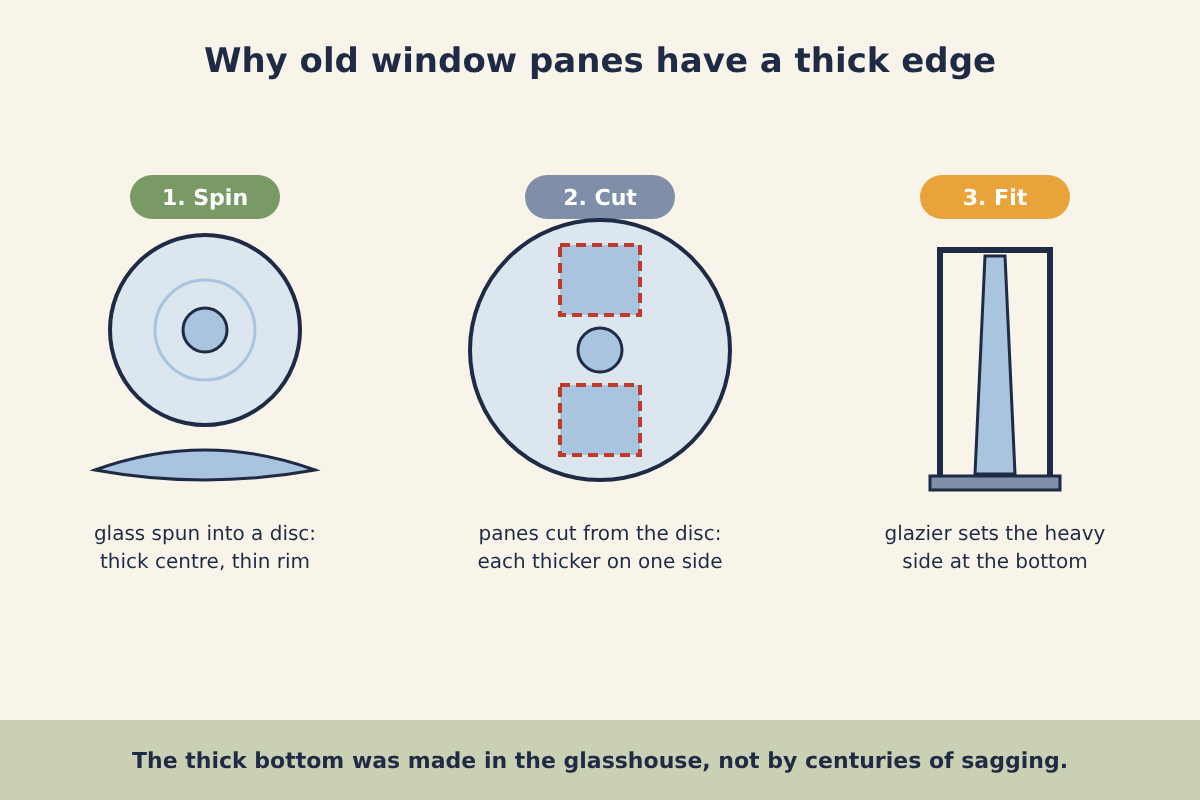
In the cylinder process, used for much medieval glass, the glassmaker blew a long cylinder, cut it open and flattened it into a sheet by hand. That also gave sheets of uneven thickness.
When a glazier fitted a pane with one thick edge into a frame, the obvious choice was to put the heavier edge at the bottom, where it sat more securely. Plumb's explanation in 1989 rested on exactly this: the thickness pattern comes from the manufacture, not from flow.
One honest caveat: nobody seems to have run a large statistical survey of old windows to measure how often, and by how much, panes are thicker at the bottom. The case against flow does not need one. The manufacturing methods explain where the thick edges came from, and the viscosity calculations show that gravity could not have produced them.
Is glass a liquid or a solid, then?
This is the part of the myth with a grain of truth in it. Glass is an unusual material, and physicists still study the glass transition, the range of temperatures over which a cooling liquid stiffens into a glass. Glass does lack the ordered structure of most solids.
But "its atoms are arranged like a liquid's" does not mean "it flows like a liquid". On every timescale that matters to people, from a lifetime to the whole history of building with glass, window glass behaves as a solid: it holds its shape, it breaks rather than drips, and it stays put in its frame. Calling it an amorphous solid is both the standard term and the most useful description.
Why the myth lasts
It survives for the same reasons many good-sounding science facts do. It links a strange-but-true idea (glass has a liquid-like structure) with something people can see for themselves (thick-bottomed old panes), and the link feels like a satisfying discovery. It was taught in classrooms, which gave it authority. And it is hard to check without measuring glass or doing the viscosity sums.
Other science myths work the same way. The claim that lightning never strikes the same place twice also takes a real observation and draws the wrong rule from it, and the belief that we only use 10% of our brains spread partly because it sounded like insider science. As with the story that people in the Middle Ages thought the Earth was flat, the version taught to students turned out to say more about how stories travel than about the evidence.
The short answer to pass on
Old windows are thick at the bottom because they were made unevenly and installed heavy side down. Room-temperature glass would need longer than the age of the universe to sag that much.
Sources
- Edgar Dutra Zanotto, "Do cathedral glasses flow?", American Journal of Physics 66, 392–395 (1998)
- E. D. Zanotto and P. K. Gupta, "Do cathedral glasses flow? Additional remarks", American Journal of Physics 67, 260–262 (1999)
- "Cathedral Glass Myth Shattered", Science news report on Zanotto's paper
- Robert C. Plumb, "Antique windowpanes and the flow of supercooled liquids", Journal of Chemical Education 66(12), 994–996 (1989)
- DoITPoMS, University of Cambridge teaching materials: "Do cathedral glasses flow?"
