
Did people in the Middle Ages think the Earth was flat?
The short answer
It is often said that people before Columbus believed the Earth was flat. We checked what medieval scholars wrote about the Earth's shape, and where the story came from.
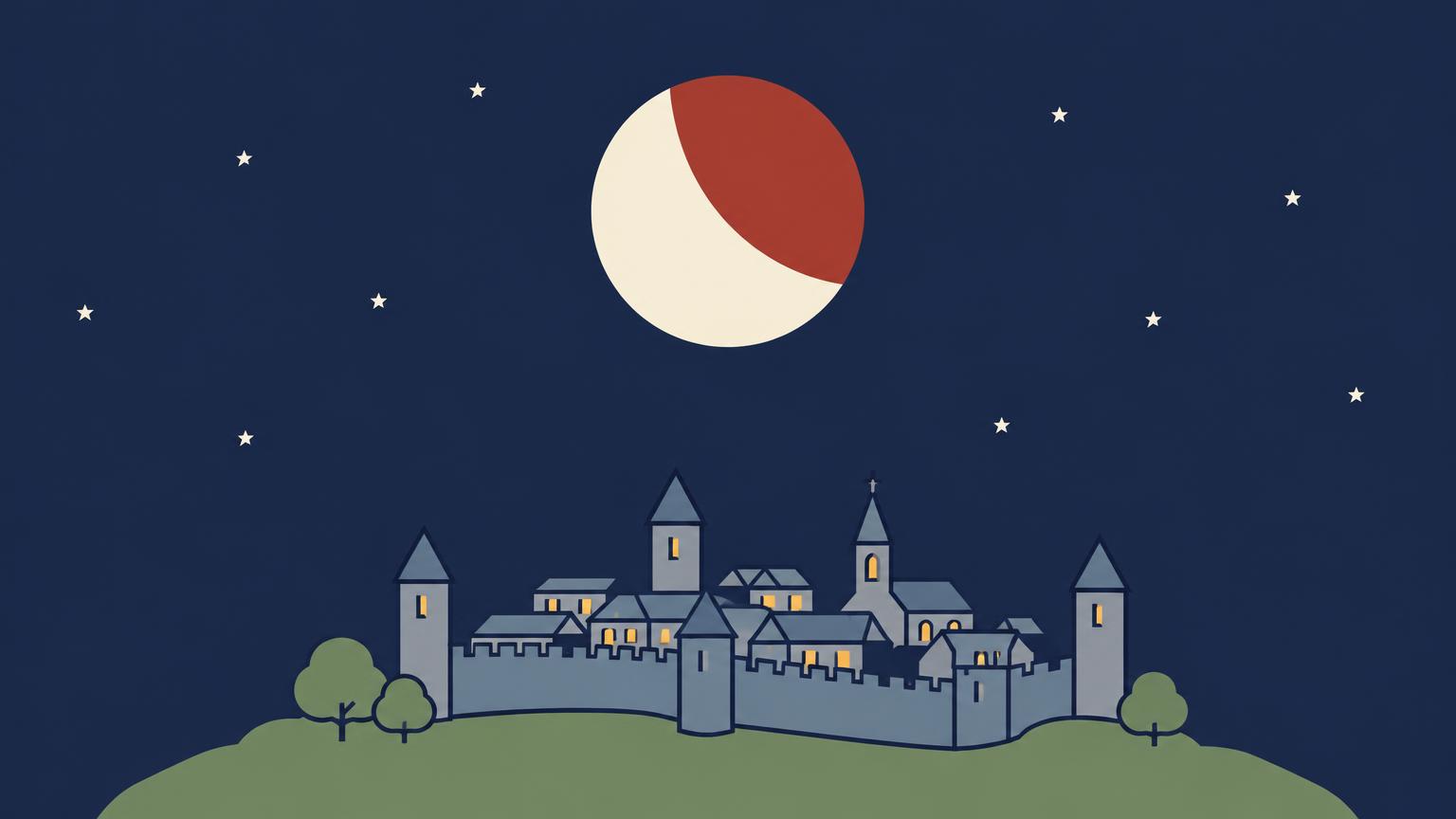
Verdict: False. Educated people in medieval Europe knew the Earth was a sphere. Greek thinkers had worked that out centuries before the Middle Ages began, medieval scholars taught it in monasteries and universities, and Christopher Columbus's critics in the 1480s were not worried that he would sail off the edge. They thought he had the size of the globe wrong, and they were right.
The idea that the Middle Ages believed in a flat Earth is much younger than the Middle Ages. It was largely spread in the 19th century, and the historian Jeffrey Burton Russell traced how in his 1991 book Inventing the Flat Earth: Columbus and Modern Historians.
What the medieval sources say
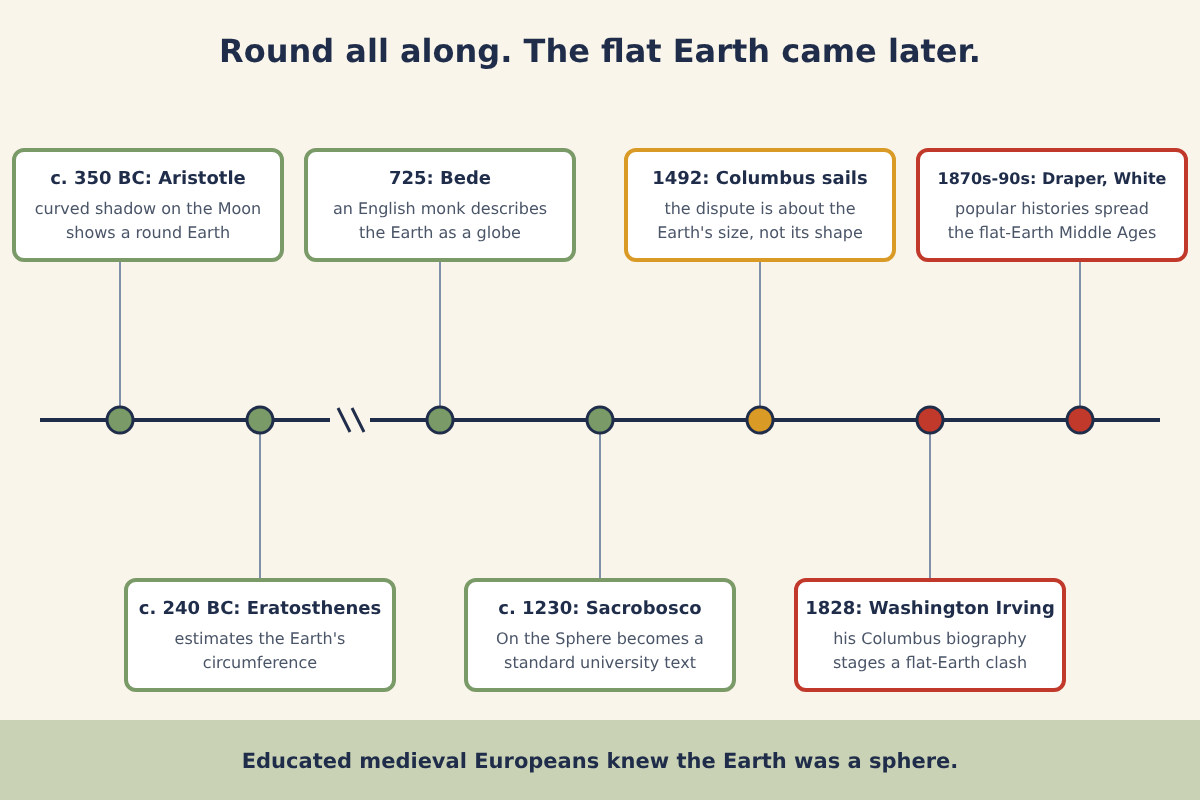
The round Earth was already old news by the year 500. In On the Heavens, written around 350 BC, Aristotle gave two pieces of evidence that anyone could check. During a lunar eclipse, the edge of the Earth's shadow on the Moon is always curved, and only a sphere casts a round shadow from every angle. And as you travel north or south, different stars rise above the horizon, which would not happen on a flat surface. About a century later, Eratosthenes, working in Alexandria, used the angle of shadows in two Egyptian cities to estimate the Earth's circumference. Historians still argue over exactly how long his unit of distance was, so they disagree about how close he came, but his method assumed a sphere.
Medieval Christian writers inherited this and kept it. In The Reckoning of Time, finished in 725, the English monk Bede described the Earth as a globe and used its roundness to explain why days are longer in summer in the north than in the south. Around 1230, Johannes de Sacrobosco wrote On the Sphere, a short introduction to astronomy that opens with the shape of the Earth. It became a standard textbook in European universities for centuries, which means generations of students learned the round Earth as basic material.
The idea turns up in literature and symbols too. In Dante's Inferno, written in the early 14th century, Dante and Virgil climb down through the centre of the Earth and come out on the other side of the world, under different stars. Kings and emperors held an orb, a ball topped with a cross, as a sign of rule over the world.
There were a few exceptions, and they get quoted a lot. Lactantius, a Christian writer around AD 300, mocked the idea that people could live on the underside of the world. In the 6th century, a merchant-turned-monk known as Cosmas Indicopleustes wrote a Christian Topography describing a flat world shaped like the biblical tabernacle. Russell's point is that neither was typical. Cosmas wrote in Greek and had little influence in the Latin West, where the scholars who shaped medieval teaching, such as Bede, took the round Earth for granted.
What we cannot say much about is what illiterate peasants pictured. They left almost no written record of their views on cosmology. The verdict here is about the educated people whose writing survives, which is also the group the myth usually accuses.
So what was Columbus arguing about?
Size. Before his first voyage in 1492, Columbus argued that Asia lay a manageable distance west of Europe. To get there, he used low estimates of the Earth's size and high estimates of how far Asia stretched east. The experts who advised against his plan worked from figures closer to the truth and concluded that no ship of the day could carry enough food and water to cross that much open ocean.
They were correct about the distance. Columbus survived because two continents nobody in Europe knew about sat in the way, roughly where he expected to find Asia.
Where the myth came from
The story of a brave Columbus facing down flat-Earth churchmen owes a great deal to Washington Irving, the American author best known for "Rip Van Winkle". His A History of the Life and Voyages of Christopher Columbus (1828) was a bestseller, and it includes a dramatic scene at Salamanca in which learned clergymen raise objections that make them sound like flat-Earthers. Irving was writing popular history with a novelist's flair, and the scene became part of the Columbus legend. Famous names attract invented moments like this, much as "Let them eat cake" was pinned on Marie Antoinette long after the story first appeared without her.
Later in the century, the idea found a bigger job. Two influential books, John William Draper's History of the Conflict between Religion and Science (1874) and Andrew Dickson White's A History of the Warfare of Science with Theology in Christendom (1896), told the history of science as a long war against religion. A medieval Church that insisted on a flat Earth made a perfect example, and both books helped fix that picture in textbooks. The palaeontologist Stephen Jay Gould retold this history in his essay "The Late Birth of a Flat Earth", in his 1995 collection Dinosaur in a Haystack.
The 19th century was busy inventing the past in other ways too: the horned helmets on popular Vikings date from the same era.
Why it is so easy to believe
The myth flatters the present. It makes the past look foolish and our own time look enlightened, and it gives Columbus a simpler, braver story than the real one, in which he was wrong about the numbers and lucky about the geography.
It also feels right if you have seen medieval maps. The famous mappae mundi, such as the Hereford map from around 1300, show the world as a flat disc with Jerusalem at the centre. But those maps were never meant as navigation charts. They were teaching pictures of history, religion and the known lands, and drawing a round Earth on a flat surface means flattening it, just as every school atlas still does. A modern world map on a classroom wall does not mean the teacher thinks the planet is flat either.
Like the story behind "rule of thumb", this is a myth that tells us more about the century that spread it than about the people it describes.
