
Did Marie Antoinette really say "Let them eat cake"?
The short answer
Few quotes are pinned on anyone as firmly as "Let them eat cake" on Marie Antoinette. We checked where the line first appears in print and who it was first said about.
Verdict: False. There is no evidence that Marie Antoinette ever said "Let them eat cake". The line was already in print as a story about an unnamed "great princess" written down by Jean-Jacques Rousseau while she was still a child in Austria, and it was pinned on her long after the fact.
The quote has stuck to her for good reasons. She was a foreign-born queen with a famously expensive court, France really did go through bread shortages in her time, and the line sums up a whole idea of royal indifference in four words. A story that fits that neatly is easy to believe.
The line came from Rousseau, not Versailles
The earliest known version is in the Confessions, the autobiography of the philosopher Jean-Jacques Rousseau. In Book 6, Rousseau describes a moment from around 1740, when he was living in Lyon as a tutor to the sons of Jean Bonnot de Mably. He wanted some bread to go with a little wine but felt too awkward to go into a baker's shop. Then, he writes, he remembered the answer of a "great princess" who was told that the peasants had no bread and replied: "Qu'ils mangent de la brioche", "Let them eat brioche".
Rousseau never says who the princess was. He may have heard the story from someone else, and he may have improved it; the Confessions is a lively book, and historians do not treat every anecdote in it as a reliable record.
What matters most is the date. Rousseau wrote the first six books of the Confessions between about 1765 and 1767, and they were published in 1782, after his death in 1778. Marie Antoinette was born in Vienna in November 1755. When Rousseau was writing that passage she was around ten years old and living at the Austrian court. She did not marry the future Louis XVI and move to France until 1770.
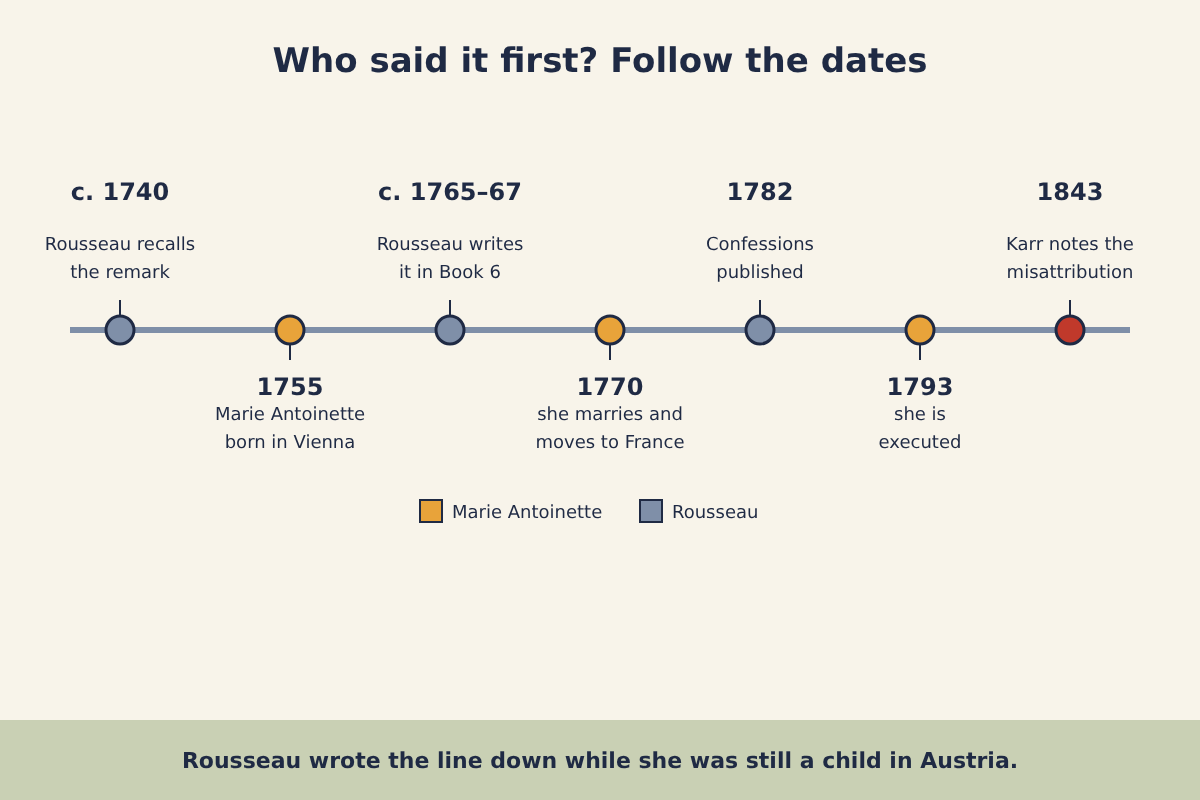
So the "great princess" cannot have been a French queen who had not yet set foot in France, and Encyclopaedia Britannica judges the attribution to her almost certainly apocryphal.
It was brioche, not cake
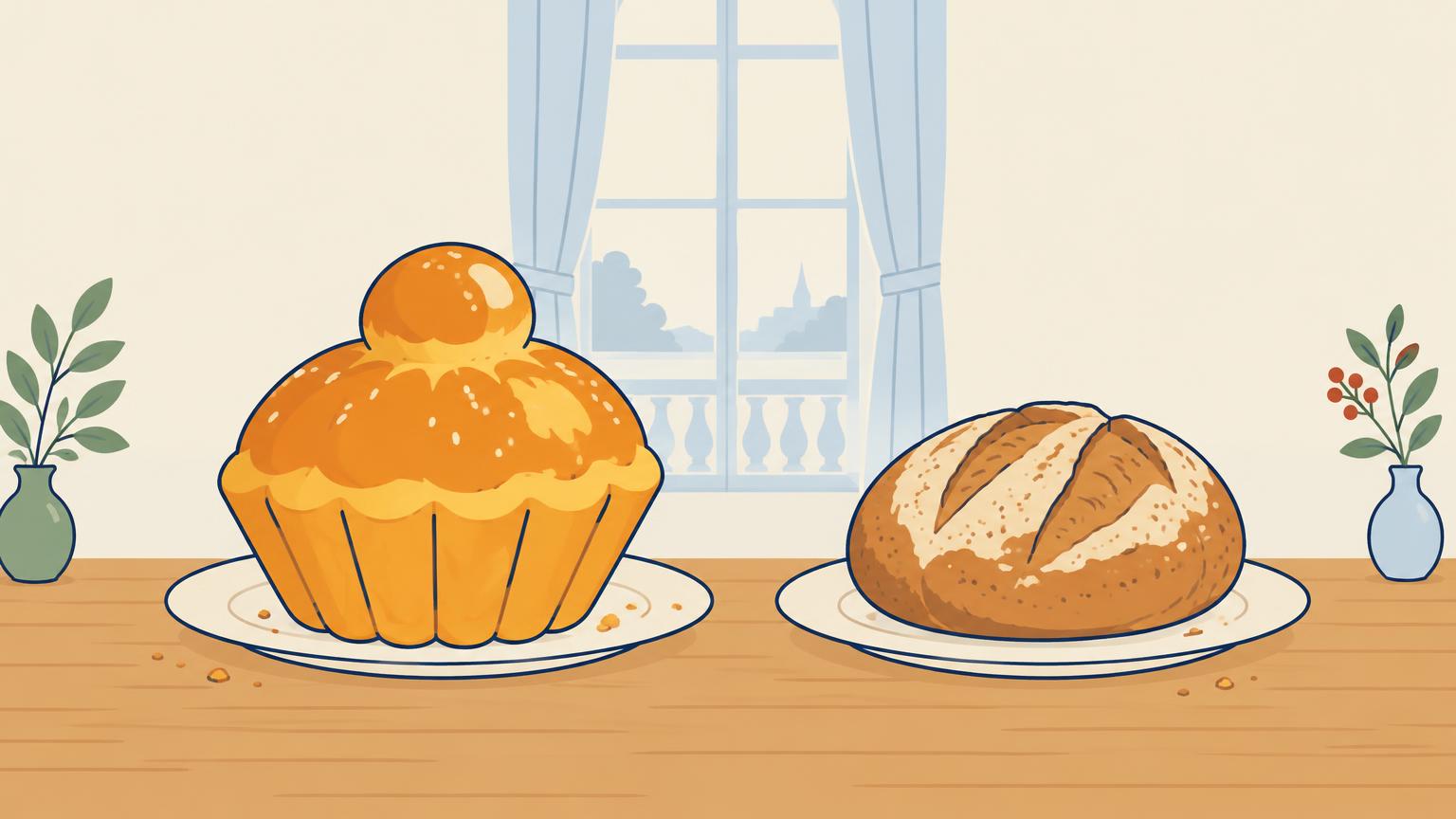
The English version also loses something in translation. Rousseau's princess says brioche, not cake. Brioche is a bread enriched with eggs and butter: softer and richer than an ordinary loaf, but still bread. The point of the story is the same either way, a royal who has no idea what being poor means, but "cake" makes it sound sillier than the original.
Other candidates for the "great princess"
People have been trying to name Rousseau's princess for a long time, and the suggestions point backwards, not forwards.
Louis XVIII, Marie Antoinette's brother-in-law, wrote in a memoir of 1791 that a similar line had been said by Marie-Thérèse of Spain, the wife of Louis XIV, who died in 1683. In his version the remark was about eating the crust of a pâté. That is a much later account of something said a century earlier, so it is weak evidence too, but it shows the story was already being told about other royal women.
The historian Antonia Fraser, in her biography of Marie Antoinette, makes the same point and argues that the remark is out of character for the queen. Whatever her extravagance, Fraser notes, Marie Antoinette gave generously to charity and showed concern for the poor.
When did the quote get attached to her?
Not in her lifetime, as far as anyone can show. No record from Versailles or from people around her has her saying it. Reference works note that the attribution appears decades after her death.
By 1843 the link was common enough that the French writer Alphonse Karr took the trouble to knock it down. In his satirical journal Les Guêpes he pointed out that the phrase could be found in a book dated 1760, when Marie Antoinette was about five years old and still far from France, so the story about her had to be false. So one of the earliest writers on record discussing the attribution brought it up only to reject it.
Why it stuck anyway
The bread crises were real. In the spring of 1775, shortly after Louis XVI came to the throne and a few weeks before his coronation, rising grain prices led to riots in and around Paris, later called the Flour War. Hunger and bread prices stayed at the centre of French politics through the Revolution.
At the same time, Marie Antoinette was the target of a flood of pamphlets and gossip in the 1780s that painted her as frivolous, foreign and wasteful. Some of that reputation she earned, and much of it was invented. A line about a princess who could not imagine people without bread fitted the image so well that it simply moved over to her. She was executed in Paris in October 1793, and the legend grew in the retelling.
This is a pattern that turns up again and again in popular history. A memorable line or image is attached to a famous person or period long after the fact, and it outlives the correction. The horned helmets on Vikings and the medieval "flat Earth" both grew the same way, from later writers and artists rather than from the people they describe.
The short answer to pass on
"Let them eat cake" was "let them eat brioche", and Rousseau wrote it down about an unnamed princess while Marie Antoinette was a child in Vienna. No one has found any evidence that she said it.
Sources
- Jean-Jacques Rousseau, Confessions, Book 6 (written c. 1765–67, published 1782)
- Encyclopaedia Britannica, "Did Marie-Antoinette Really Say 'Let Them Eat Cake'?"
- Antonia Fraser, Marie Antoinette: The Journey (2001)
- Alphonse Karr, Les Guêpes (1843)
