
Did Vikings really wear horned helmets?
The short answer
False. No Viking Age helmet ever found has horns. The real ones are plain iron caps; the horned look comes from 19th-century art and an 1876 opera costume, and the only real Scandinavian horned helmets are about 1,700 years older than the Vikings.
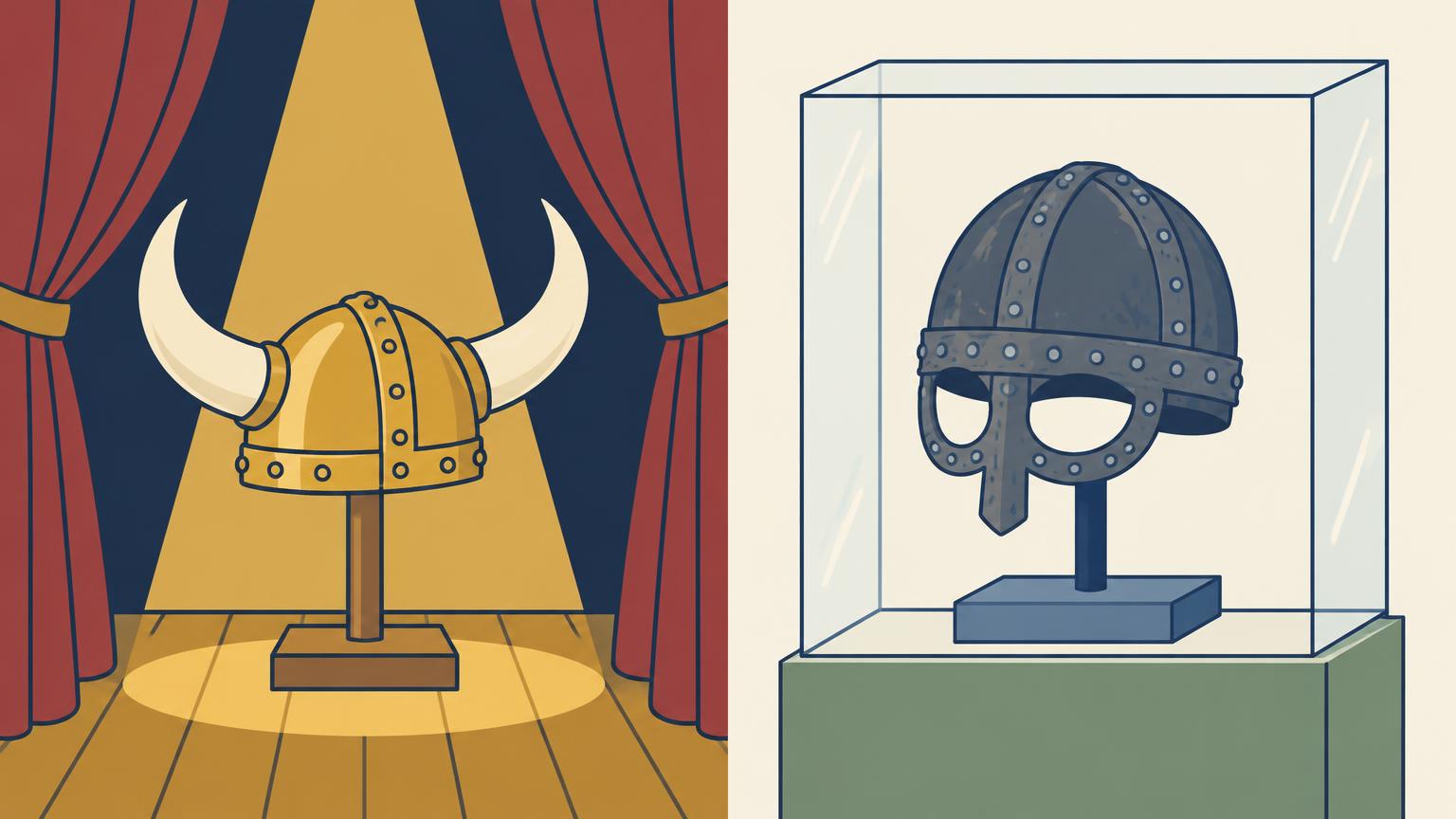
Verdict: False. There is no evidence that Vikings wore horned helmets, in battle or anywhere else. The helmets archaeologists have found from the Viking Age are plain, rounded iron caps, and the horned look that every costume shop sells was popularised in the 19th century, most famously by the costumes for the first full staging of Richard Wagner's opera cycle Der Ring des Nibelungen in 1876.
There is a real twist, though. Horned helmets did exist in Scandinavia. They are simply far older than the Vikings, by well over a thousand years.
What Viking helmets actually looked like
The best evidence is the Gjermundbu helmet, found in 1943 on a farm near Haugsbygd in southern Norway, in a 10th-century burial. It is an iron cap with a rounded dome, built from several plates held together by bands, with a guard around the eyes and nose that looks a little like a pair of spectacles. It has no horns, no wings and no fixings where either might have been attached.
That helmet is unusually complete, and the rarity matters. Only a handful of Viking Age helmets survive, most of them in fragments. The other well-preserved example is the Yarm helmet, found in North Yorkshire in the 1950s; researchers at Durham University concluded that it was made in northern England in the 10th century, in the same general style as Gjermundbu. Again: a rounded cap, a face guard, no horns.
So few helmets survive that many historians think most Viking warriors fought without one at all, or wore leather caps that have long since rotted away. Iron was expensive, and a good helmet was a sign of wealth. What the evidence does not show, anywhere, is a horn sticking out of the side.
There is also a practical point that historians often make. A horn on a fighting helmet gives an opponent's blade or axe something to catch, and it adds weight to a piece of kit meant to deflect blows. Nobody can prove a negative from common sense alone, but it fits the finds: the helmets people actually fought in were smooth.
Where the horns really come from
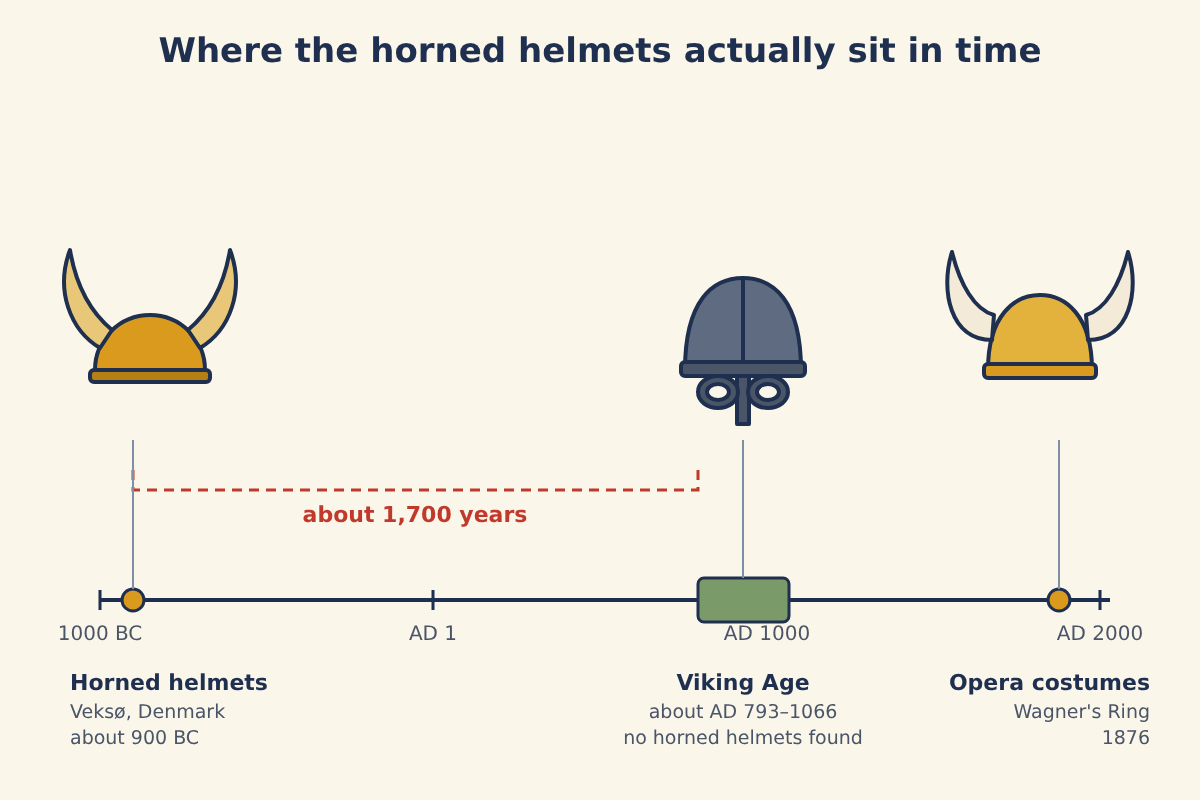
In 1942, peat cutters at Veksø on the Danish island of Zealand found two bronze helmets with long curved horns. They are now in the National Museum of Denmark, and for decades they were sometimes described as "Viking helmets". They are not. A study led by archaeologist Helle Vandkilde, published in Praehistorische Zeitschrift in 2022 and reported by Smithsonian Magazine, radiocarbon-dated organic material on the helmets to around 900 BC. That puts them in the Nordic Bronze Age, roughly 1,700 years before the first recorded Viking raids at the end of the 8th century.
These were almost certainly ceremonial objects rather than battle gear. They were deposited in a bog, a common way of offering valuable things in Bronze Age Scandinavia, and the researchers link the horned-helmet imagery to similar figures in Bronze Age Sardinia and Iberia. Not every archaeologist accepts that wider connection, but nobody disputes the date: these helmets belong to a world that had vanished long before any Viking set sail.
Horns and horn-like crests also turn up in a few later Scandinavian images of gods, ritual dancers or warriors, from before and during the Viking Age. Scholars generally read these as religious or mythological figures, not as a record of what ordinary fighters wore.
How the myth was made
The horned Viking is a 19th-century creation. The image grew instead out of the Romantic fascination with the Norse past that swept northern Europe in the 1800s. Painters and illustrators, among them the Swedish artist Gustav Malmström in his illustrations for the epic poem Frithiof's Saga, gave their heroes horns and wings to make them look ancient, wild and grand. The scholar Roberta Frank traced this process in detail in a 2000 essay, "The Invention of the Viking Horned Helmet".
The image that stuck came from the stage. For the first complete performance of Wagner's Ring cycle at Bayreuth in 1876, the costume designer Carl Emil Doepler dressed several characters in horned helmets. The Ring is based on Germanic and Norse myth rather than on Viking history, but audiences did not draw that distinction, and the costumes spread through later productions, posters and book illustrations. From there it was a short step to cartoons, sports mascots and every fancy-dress shop in the world.
Why so many people believe it
It is an easy myth to fall for, and not a foolish one. Horned helmets really did exist in Scandinavia, and for most of the 20th century the Veksø pair was casually linked to Vikings. Museums, textbooks and films repeated the image for generations. And the horns do a job no plain iron cap can: they make a figure instantly recognisable as a Viking from across a room, which is exactly why costume designers and cartoonists keep using them.
The real picture is less dramatic and more interesting. The Vikings fought in smooth iron caps if they could afford one and in no helmet if they could not. The horns belong partly to Bronze Age priests or ritual dancers who lived three thousand years ago, and partly to an opera costume designer in 1870s Germany.
If you want to see what a Viking actually wore on their head, look for a photograph of the Gjermundbu helmet. It is the most famous Viking helmet in the world, and it has no horns at all.
