
Does lightning never strike the same place twice?
The short answer
False. Lightning hits the same places again and again: the National Weather Service says the Empire State Building is struck about 23 times a year. Here is why tall, isolated things keep getting hit, and where the old saying came from.
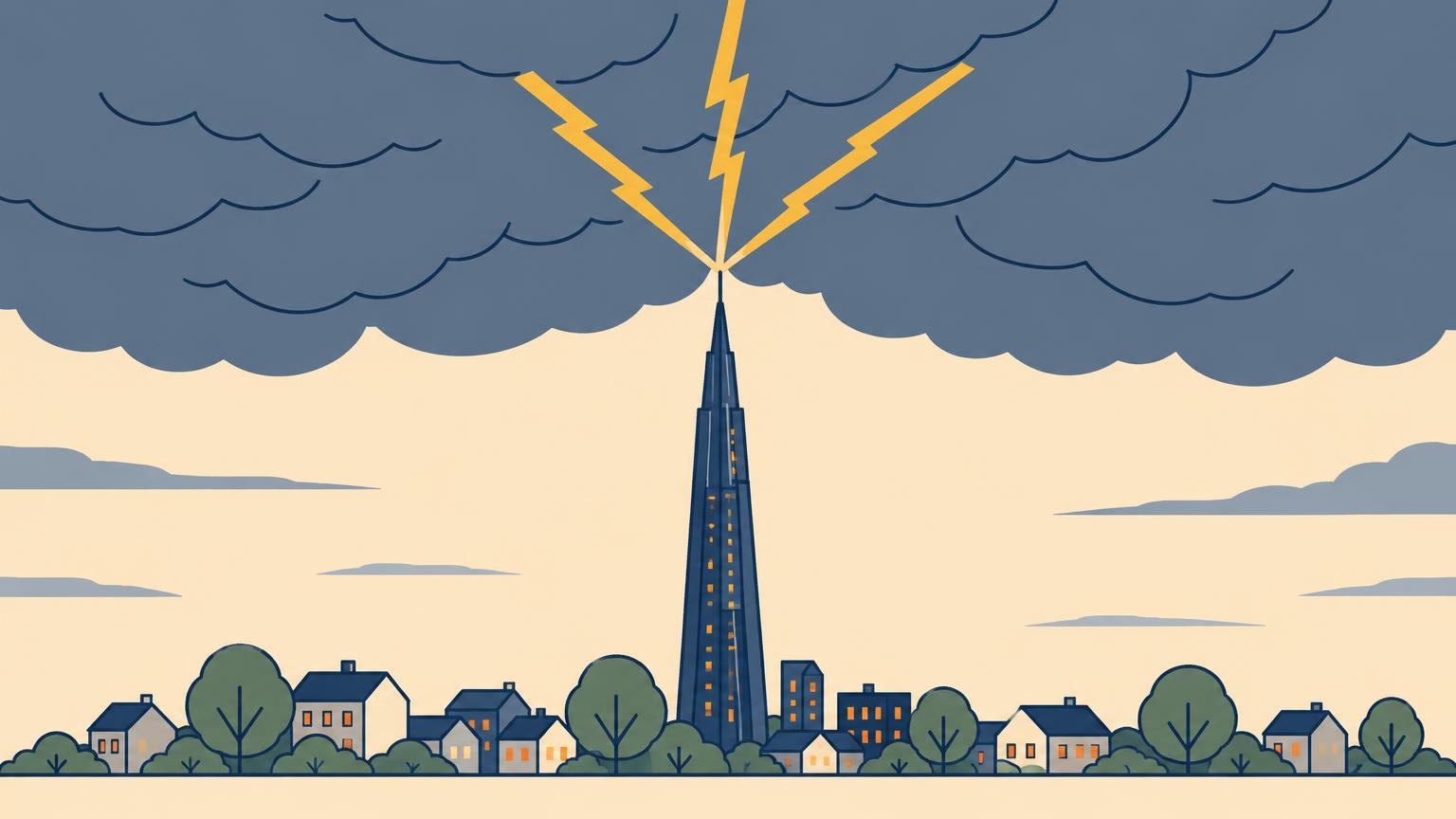
Verdict: False. Lightning strikes the same place again and again, and some places get hit dozens of times a year. The US National Weather Service lists "lightning never strikes the same place twice" among its lightning myths and puts it plainly: lightning often strikes the same place repeatedly, especially a tall, pointed, isolated object. Its example is the Empire State Building, which it says is hit an average of 23 times a year.
As a figure of speech about bad luck, the saying is fine. As weather science, it is backwards.
What the evidence says
The clearest source is the National Weather Service's lightning myths page, which takes this claim on directly and answers it with the Empire State Building figure above. Tall buildings, radio and TV masts and communication towers are struck so often that engineers fit them with lightning protection as standard. They do not expect the first strike to be the last.
Repeat strikes also happen on a much smaller scale than a skyscraper. A single lightning flash is often made of several separate strokes, one after another, a fraction of a second apart. The later strokes usually travel down the channel the first one opened, so the same spot on the ground is hit several times within a single flash. That rapid repeat is what makes lightning appear to flicker. Not every flash works this way; studies with high-speed cameras have found that many multi-stroke flashes touch down in more than one place. But a spot that is hit more than once in under a second is ordinary lightning behaviour, not a freak event.
People are not exempt either. Guinness World Records lists Roy Sullivan, a ranger at Shenandoah National Park in Virginia, as the person struck by lightning the most recorded times: seven, between 1942 and 1977, and he survived all seven. His job kept him outdoors in the Blue Ridge Mountains through decades of summer storms, which goes a long way toward explaining the record.
Why tall things keep getting hit
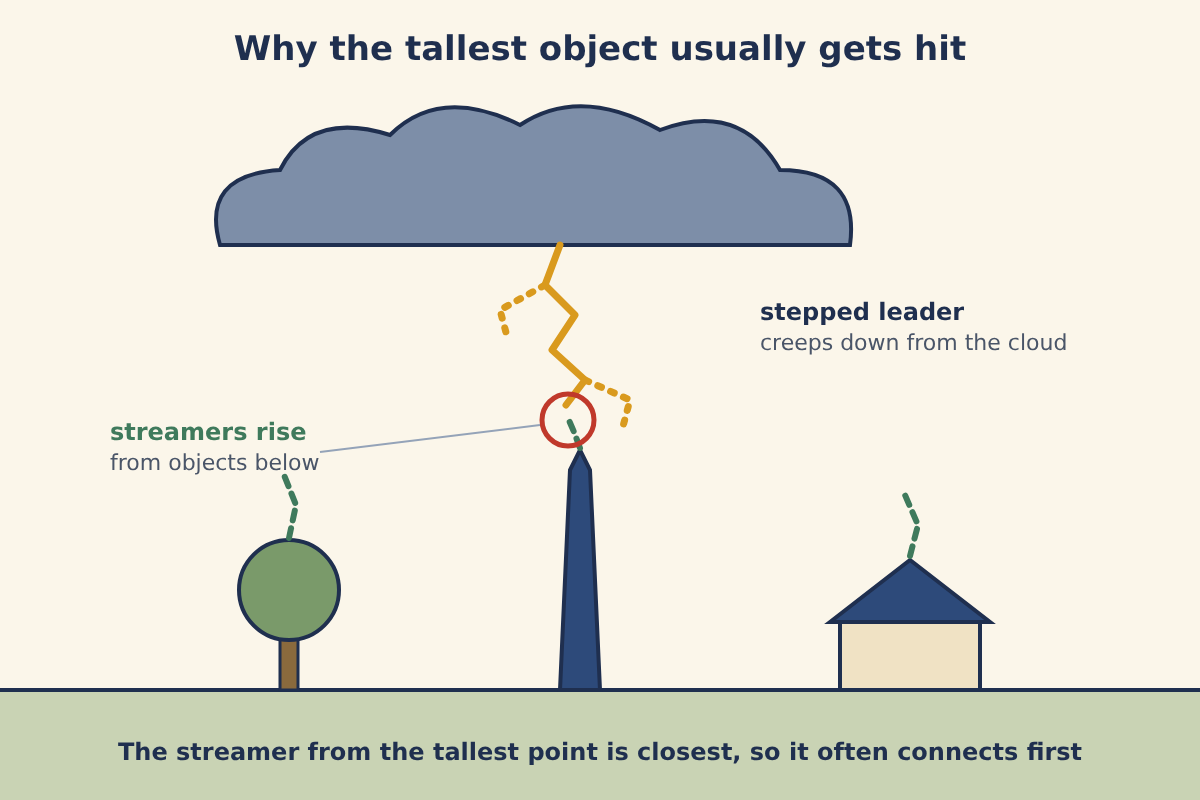
The reason is in how a strike forms. As NOAA's National Severe Storms Laboratory explains, a cloud-to-ground flash begins with a faint, branching channel of charged air, called a stepped leader, that works its way down from the cloud in short jumps. As it nears the ground, the strong electric field pulls positive charge up from objects below, and they send up sparks of their own, called streamers. When a leader and a streamer meet, the circuit is complete and the bright return stroke flashes up the channel.
Tall, pointed objects stick up into the strongest part of that electric field, so their streamers start sooner and reach higher. That gives them the best chance of meeting the leader first. A strike leaves the tower exactly as tall and pointed as it was before, so in the next storm it is still the most likely meeting point. Location matters in the same way: a lone tree in a field or a mast on a hilltop is the tallest thing for some distance, which is why lightning protection and lightning safety advice both focus on height and isolation.
None of this means lightning always picks the tallest object. The leader's path is partly random, and lightning can and does hit open ground, low buildings or people standing near taller things.
Height raises the odds. It does not guarantee the outcome, and the places that have been hit before stay the places most likely to be hit again.
Where the saying came from
The saying is old, and its exact origin is unclear. Word researcher Barry Popik has traced versions of it in American newspapers back to the 1830s, with "lightning was never known to strike twice in one place" appearing in 1830 and the familiar "same place" wording by 1851. Some phrase dictionaries credit later books with the first use, but those dates come after the newspaper examples, so the saying was probably in common speech well before anyone wrote it into a novel.
It is easy to see why it caught on. For any one ordinary spot, such as your garden or your roof, a lightning strike is rare, and two in a lifetime would be rarer still. The phrase was mostly used to reassure people that a rare misfortune would not repeat, and as reassurance it sounds right. It only goes wrong when you take it literally and apply it to the places lightning actually favours.
The useful takeaway
If something nearby has been struck before, such as a tall tree, a hilltop or a mast, that is a reason to keep away from it in a storm, not a reason to feel safe. The National Weather Service's short version of its safety advice is "When thunder roars, go indoors": an enclosed building or a hard-topped car is far safer than shelter under the tallest thing around.
