
Do we only use 10% of our brains?
The short answer
The idea that we use only a tenth of our brains turns up in films, adverts and self-help books. Here is what brain scans and neuroscience say, and where the 10% figure came from.
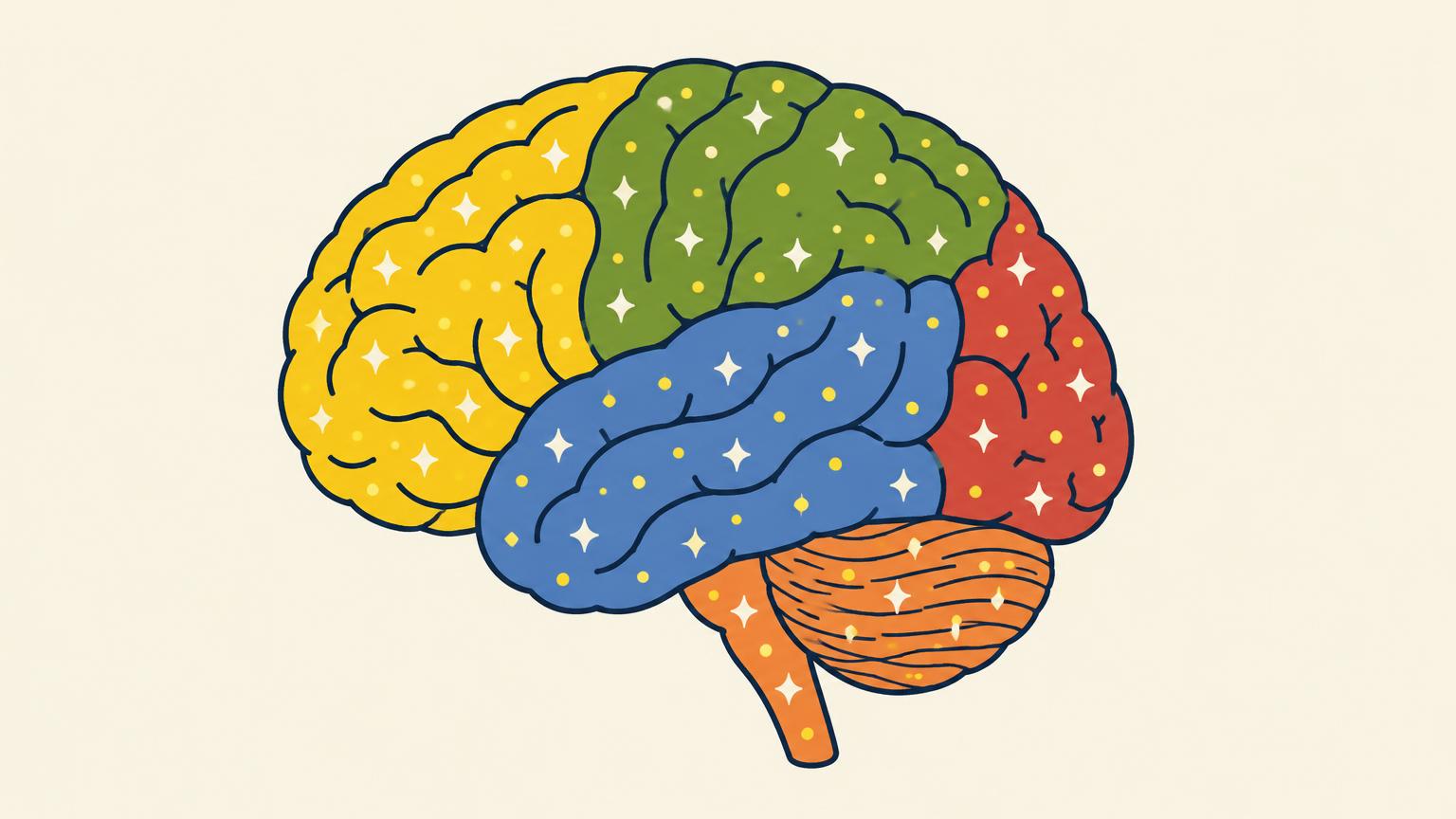
Verdict: False. You use far more than 10% of your brain. Over an ordinary day, practically every region of it does some work, and there is no large reserve of idle tissue waiting to be switched on. Neuroscientists have taken the claim apart many times, most thoroughly the psychologist Barry Beyerstein in "Whence cometh the myth that we only use 10% of our brains?", a chapter in the 1999 book Mind Myths, edited by Sergio Della Sala. Scott Lilienfeld and colleagues put it first in their 2010 book 50 Great Myths of Popular Psychology.
There is a small grain of truth buried in it, which comes at the end. But the number itself has no scientific source at all.
What the evidence says
Several independent lines of evidence point the same way, which is why researchers are so confident about this one.
Brain scans. Functional imaging (PET and fMRI) measures blood flow and energy use as the brain works. Across the range of things people do in a day (seeing, moving, talking, remembering, planning, even resting with nothing in mind), activity turns up across the whole brain. Different tasks use different mixes of regions. No scan has ever found a large region that does nothing.
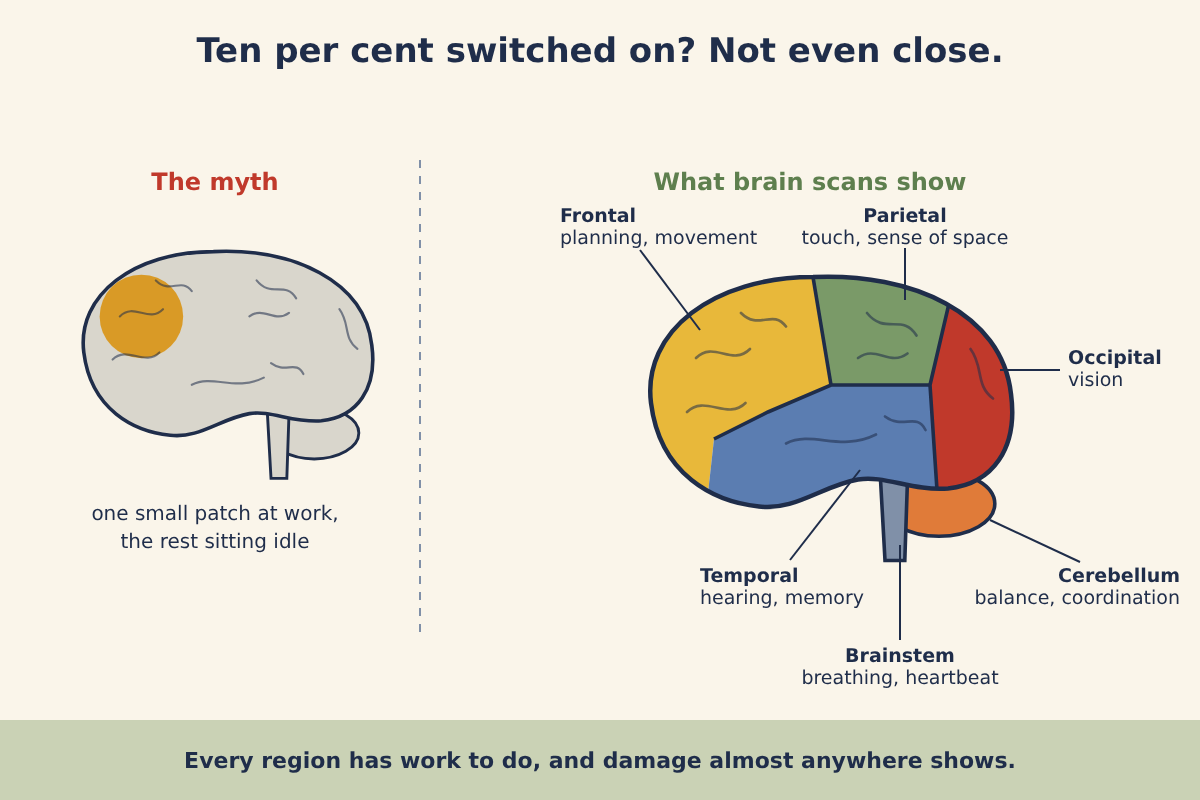
Damage. If 90% of the brain were spare, most strokes and head injuries would cause no problems, because they would land in unused tissue. That is not what neurologists see. Damage to almost any area produces some deficit, from trouble with speech or movement to changes in vision, memory or personality. The specific loss depends on where the damage is, which is itself evidence that each area is doing something.
Energy. Brain tissue is expensive to run. Marcus Raichle and Debra Gusnard, writing in PNAS in 2002, summarised the figures: the brain makes up about 2% of the body's weight but accounts for about 20% of its energy use. Evolution does not usually keep an organ that costly while leaving most of it unused. A smaller brain that did the same work would have been cheaper.
Use it or lose it. Neurons that go unused do not sit quietly in reserve. Brain cells and their connections that get no activity tend to weaken and be pruned away, so a brain that only used a tenth of itself would be expected to show large areas of wasting tissue. Healthy brains do not.
Where the 10% came from
Nobody has found a scientific study that produced the figure, and Beyerstein looked hard. What he did find was a trail of misreadings, each believable at the time.
The best-known thread runs back to the American psychologist William James. In essays around the turn of the 20th century, including "The Energies of Men" (1907), James argued that most people meet only a small part of their mental potential. It was a point about effort and habit, and he gave no percentage. According to Beyerstein, the number appears to have been attached later, notably in Lowell Thomas's preface to Dale Carnegie's 1936 bestseller How to Win Friends and Influence People, which credited James with saying that the average person develops only ten per cent of their latent mental ability. Self-help writing has been repeating it ever since.
Early brain science supplied more raw material. In the late 19th and early 20th centuries, researchers who stimulated the exposed brain with small electric currents found that some areas produced no obvious movement or sensation. These were sometimes called "silent" cortex. We now know those areas handle things like language, planning and integrating information, which a twitch of the arm would never reveal. Lesion experiments of the period, in which removing chunks of an animal's cortex did not always stop it from performing a learned task, were also read as signs of spare capacity. Physics has a similar case in the classroom claim that old windows are thicker at the bottom because glass flows: a real question about what glass is, stretched into a conclusion the evidence never supported.
A third possible source is a muddled cell count. The brain contains neurons and supporting cells called glia, and it was long repeated that glia outnumber neurons ten to one, which some took to mean only a tenth of the brain does the thinking. Even the count was wrong. Frederico Azevedo and colleagues (Journal of Comparative Neurology, 2009) estimated about 86 billion neurons in the human brain and a similar number of non-neuronal cells, and a 2016 review in the same journal by Christopher von Bartheld, Jami Bahney and Suzana Herculano-Houzel concluded that the ratio is roughly one to one. Glia are also busy in their own right, supporting and regulating the neurons around them.
The line is also often credited to Albert Einstein. No one has found a source showing he said it, a familiar fate for a convenient line in need of a famous author. Factuos found the same pattern with the "Judge Thumb" story behind rule of thumb, a legend that leaned on a real name for credibility.
Why it is so easy to believe
The myth flatters us. If you only use a tenth of your brain, then genius, perfect memory or something stranger is sitting inside you, waiting to be unlocked. That promise has sold self-help courses for decades, and it gives fiction a handy premise: the 2014 film Lucy is built around a woman whose brain usage climbs past 10% toward 100%.
It also matches a real experience. Most of us feel we could think more clearly, learn faster or focus better than we usually do, and "most of your brain is idle" sounds like an explanation for that gap. The gap is real; the explanation is wrong. Getting better at something changes how efficiently existing circuits work and how they connect. It does not wake up dormant tissue.
Like the saying that lightning never strikes the same place twice, it is short, memorable and sounds like the kind of thing a scientist might have said, which goes a long way.
The grain of truth
At any single instant, only a fraction of your neurons are firing hard. That is by design. Brain cells signal partly through which ones are active and which are not, so a brain in which every neuron fired at once would carry no information. It would look more like a seizure than a thought. The vision scientist Peter Lennie, in a 2003 paper in Current Biology on the energy cost of the cortex, estimated that the brain's energy budget allows only a small percentage of cortical neurons to be highly active at the same time.
So "only some of your brain is busy right now" is true, in the same way that only some of the keys on a piano are pressed in any one chord. Over the course of a day, though, the whole keyboard gets played. Nothing in there is waiting to be unlocked, because none of it was ever switched off.
