
Did "the whole nine yards" come from machine-gun belts?
The short answer
A popular story traces the phrase to machine-gun belts in Second World War fighter planes. We followed it back through old newspapers and tested the belts, along with the kilts, concrete trucks and ships.
Verdict: False, and the real origin is Unproven. "The whole nine yards" did not come from Second World War machine-gun belts, because the phrase was already in American newspapers by 1907. Where it did come from is still unknown. Every popular explanation, from kilts to concrete trucks, falls apart on the same evidence.
If you have heard the machine-gun story, you heard a good one. It has a vivid image (a gunner firing off the entire belt of ammunition), a reason for the exact number (a belt that was supposedly nine yards long), and a meaning that fits: giving everything you have. That is why it is the version most people pass on.
What the old newspapers show
The case was cracked open by researchers searching digitised local newspapers, with much of the key digging credited to the researcher Bonnie Taylor-Blake.
The earliest known example is from The Mitchell Commercial, a small-town paper in Mitchell, Indiana, on 2 May 1907. It appears in a piece about baseball, and the wording is slightly different: "the full nine yards". A year later, on 4 June 1908, the same paper used "the whole nine yards" in the sense we know today, and this time the context had nothing to do with baseball.
There was a rival version around the same time. "The whole six yards" turns up in 1912 in the Mount Vernon Signal in Kentucky, and also in South Carolina papers of the period.
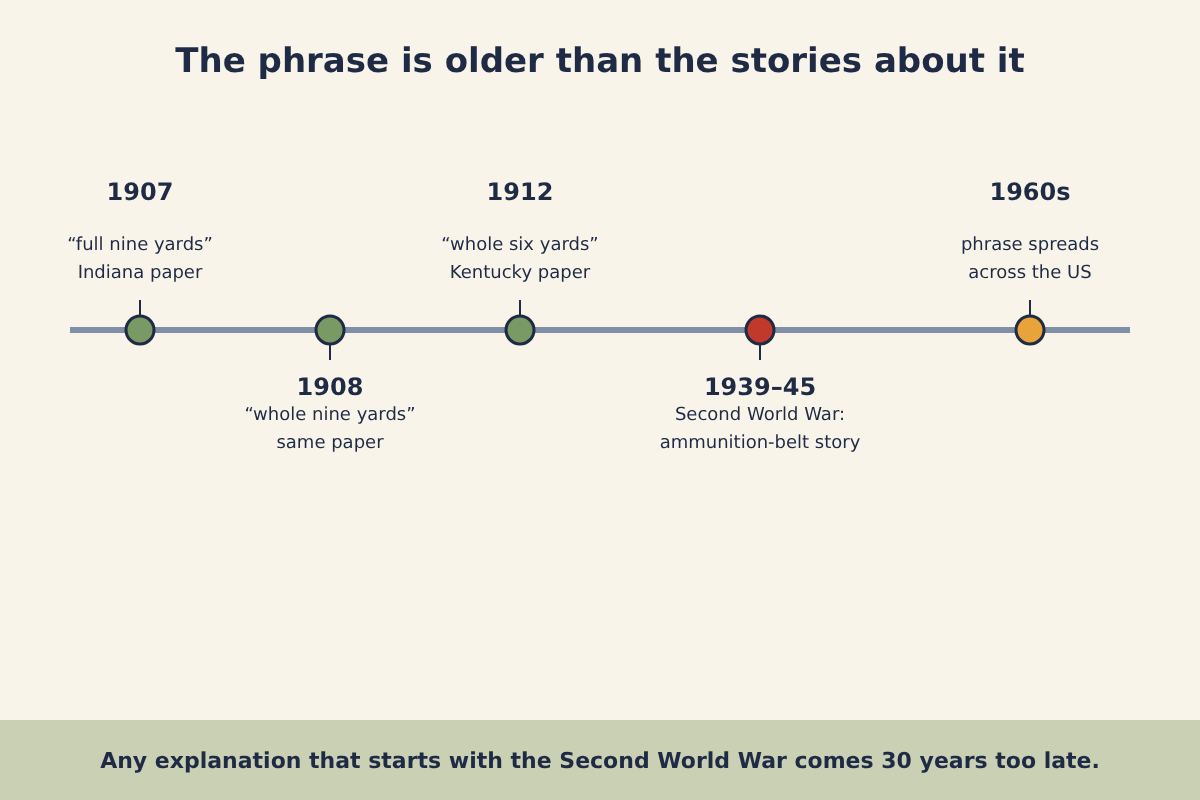
Those dates settle the machine-gun theory, and any other story that begins in either world war. A phrase cannot come from something that happened after people were already using it.
The six yards variant is a clue of a different kind. If the number could be six as well as nine, the phrase probably did not name a single object of a fixed size, such as one belt, one bolt of cloth or one truckload. A specific, measurable "nine yards" of something would be hard to swap for six.
The rival explanations, and why none of them wins
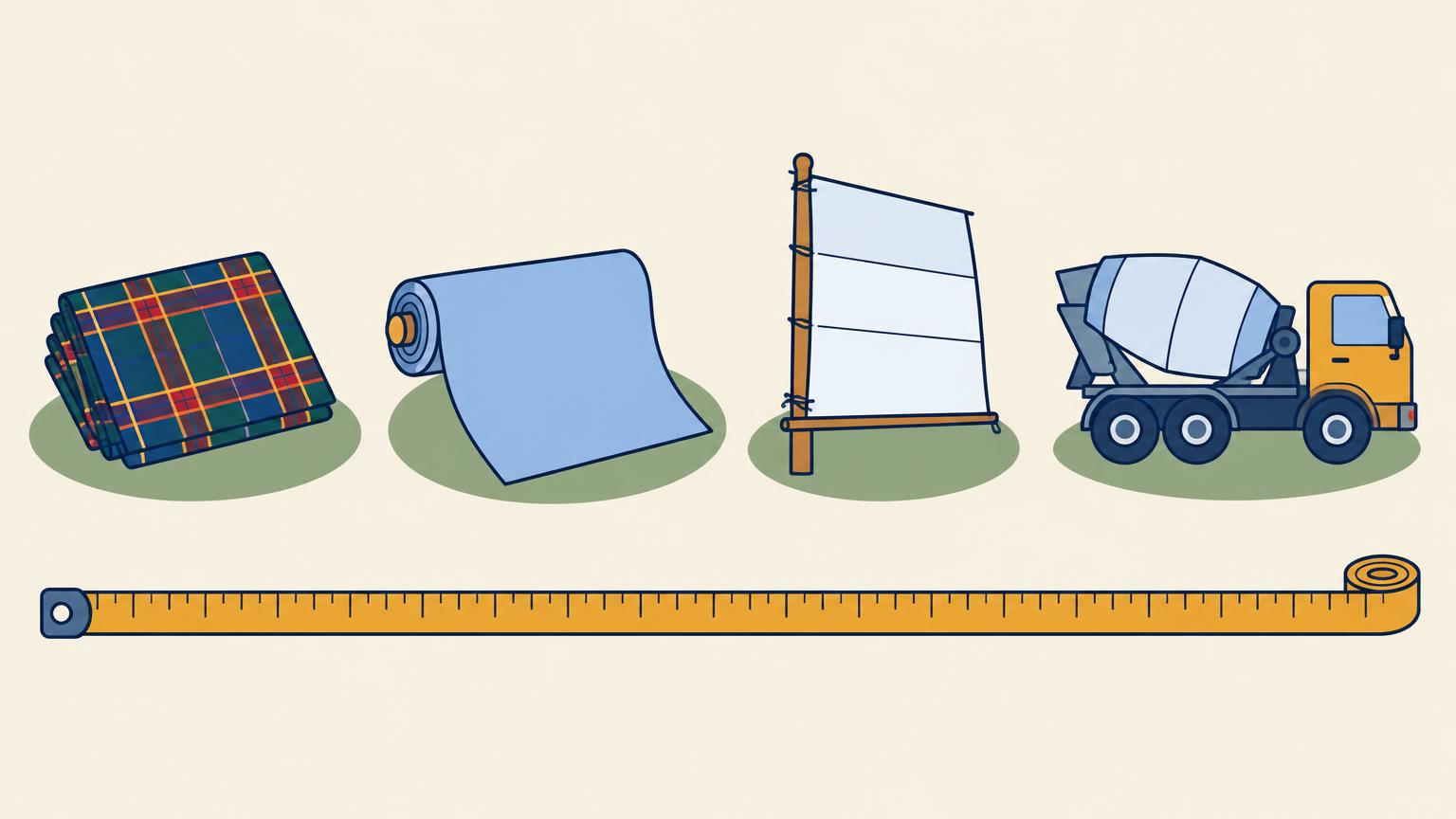
Over the years, people have offered a long list of things that are, or might be, nine yards long. A few of the best known:
- Machine-gun belts. The claim is that ammunition belts in fighter aircraft were nine yards long, so firing the whole lot meant giving it everything. The 1907 citation is more than three decades too early.
- Concrete mixer trucks. The claim is that a truck carried nine cubic yards of concrete. Nobody has found the phrase in the building trade first, and the dates are wrong again.
- Kilts or saris. A full Scottish great kilt or a long sari is said to take nine yards of cloth. There is no early evidence linking the phrase to either, and its first appearances are in rural Indiana, not Scotland.
- Square-rigged ships. The story goes that a ship with three masts carried three yards (the spars that hold the sails) on each, and "the whole nine yards" meant every sail set. Again, no early evidence connects them.
The list keeps growing, with bridal veils and American football among the other suspects. None of these has been traced back as the source. Wordorigins.org and Gary Martin's phrases.org.uk, two of the most thorough phrase-origin sites, both conclude that the origin is unresolved. The Yale librarian Fred R. Shapiro, editor of The Yale Book of Quotations, has called it "the most prominent etymological riddle of our time".
When it became famous
For decades the phrase seems to have stayed mostly regional, turning up in Midwestern and Southern papers. It did not become widespread until the early 1960s, and its sudden arrival in national use is partly why so many people assumed it must be a recent coinage with a modern, technical origin. The war stories fitted a phrase that seemed to arrive suddenly in the middle of the century.
Why the "nine yards of something" stories keep appearing
Number phrases invite this kind of explanation. When a saying contains a specific quantity, it feels as though there must be a specific thing that was measured, and once someone offers a candidate it is hard to un-hear it. The same instinct produced the false story behind "rule of thumb", where a phrase for a rough, practical method was tied, without evidence, to a supposed law about domestic violence.
It is quite possible that the number in "the whole nine yards" was never meant literally at all, and that both six and nine were just ways of saying "all of it", with nine winning out. That is a reasonable guess, but it is still a guess. Until someone finds an older source that explains itself, the honest answer is that nobody knows.
The short answer to pass on
The phrase was in print in Indiana in 1907, so it did not come from Second World War gun belts, concrete trucks or anything else from that era. Its real origin has not been found, and the earliest examples even disagree about the number.
Sources
- The Mitchell Commercial (Mitchell, Indiana), 2 May 1907 and 4 June 1908
- Mount Vernon Signal (Kentucky), 7 May 1912
- Wordorigins.org, "whole nine yards"
- Gary Martin, The Phrase Finder (phrases.org.uk), "The whole nine yards"
- Fred R. Shapiro, The Yale Book of Quotations
