
Do ostriches really bury their heads in the sand?
The short answer
Everyone knows the picture of an ostrich with its head in the sand. Here is what zoologists have seen ostriches do when danger comes, and how an ancient Roman writer started the story.
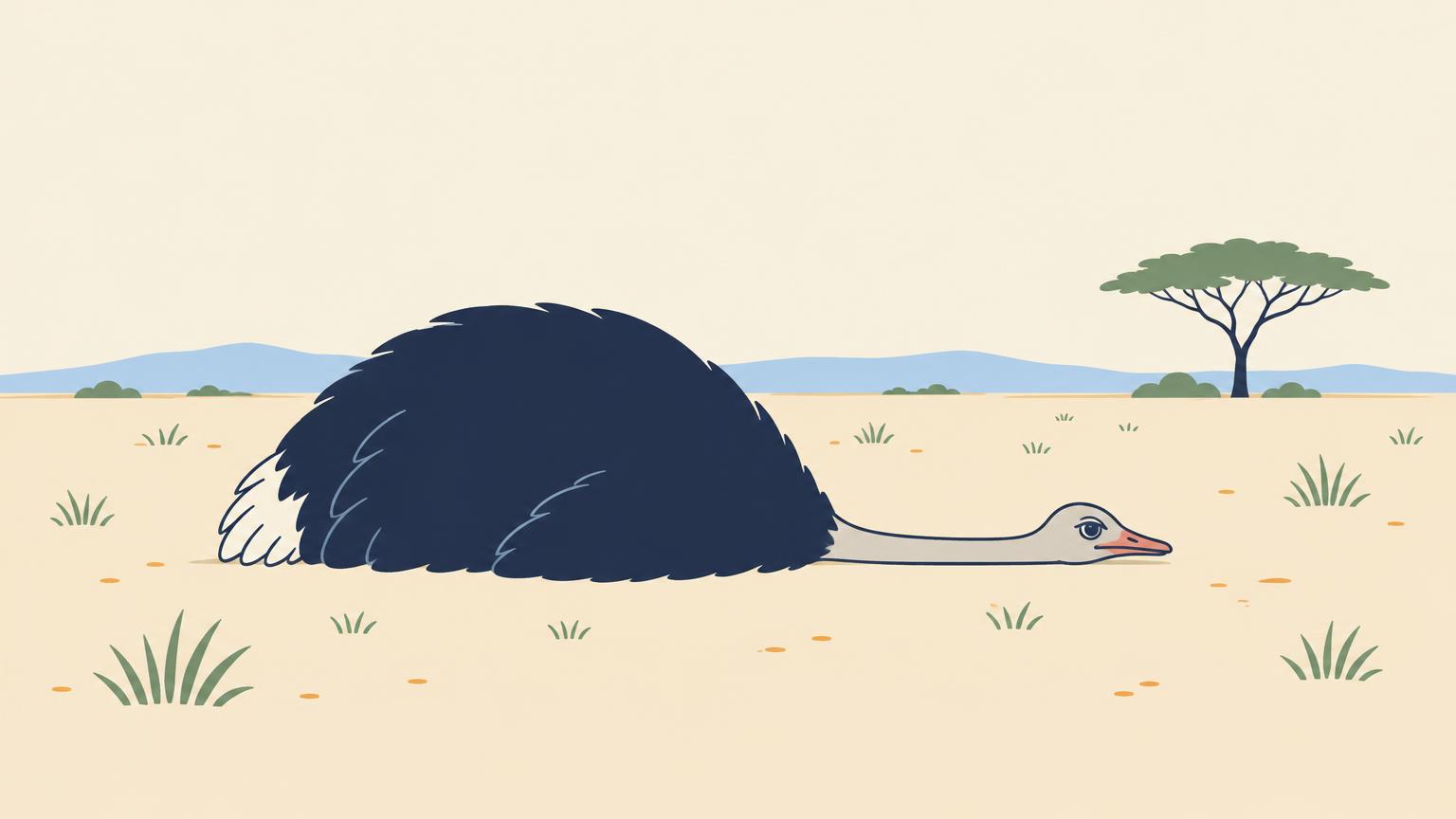
Verdict: False. Ostriches do not bury their heads in the sand, when frightened or at any other time. A bird with its head under the sand could not breathe. What they do is lie flat on the ground, dip their heads into their nests to turn the eggs, and lower their heads to feed, and from a distance all three can look like a head that has disappeared.
The myth is old, and it is believable for a simple reason: an ostrich's head is tiny compared with its body. When that small head drops out of sight against pale ground, the big dark body is all you notice.
What ostriches actually do when danger comes
An ostrich's main defence is speed. The San Diego Zoo and the Smithsonian's National Zoo both give a sprint of up to about 70 kilometres an hour (43 mph), and the San Diego Zoo says an ostrich can keep up around 50 km/h (31 mph) over a longer distance. Running away, not hiding, is its first choice.
When running is not an option, such as when it is guarding a nest, an ostrich can do something that looks a lot like the myth. According to the San Diego Zoo, a bird that senses danger and cannot run drops to the ground and stretches its head and neck flat in front of it. The light-coloured head and neck blend into the soil. From far away, only the rounded body shows, and it looks as if the head has been pushed into the sand.
It has not.
The head is lying on top of the ground, eyes open, and those eyes are worth mentioning. An ostrich's eye is almost 5 cm (2 inches) across, the largest of any land animal, according to the San Diego Zoo. Lying still with a big pair of eyes watching from ground level is a sensible way to avoid being seen.
The nest: where the head really does go down
The other likely source of the myth is the nest. Ostriches do not build a nest of twigs. The male scrapes out a shallow dip in the ground, and the eggs are laid there; the dominant female, often called the main hen, lays hers in the centre. The San Diego Zoo notes that the main hen usually sits on the eggs during the day and the male takes over at night.
The eggs have to be turned, and the birds do it with their beaks. The Cleveland Zoological Society describes ostriches turning their eggs several times a day, and that is the moment an onlooker sees an ostrich with its head down in a hole in the sand.
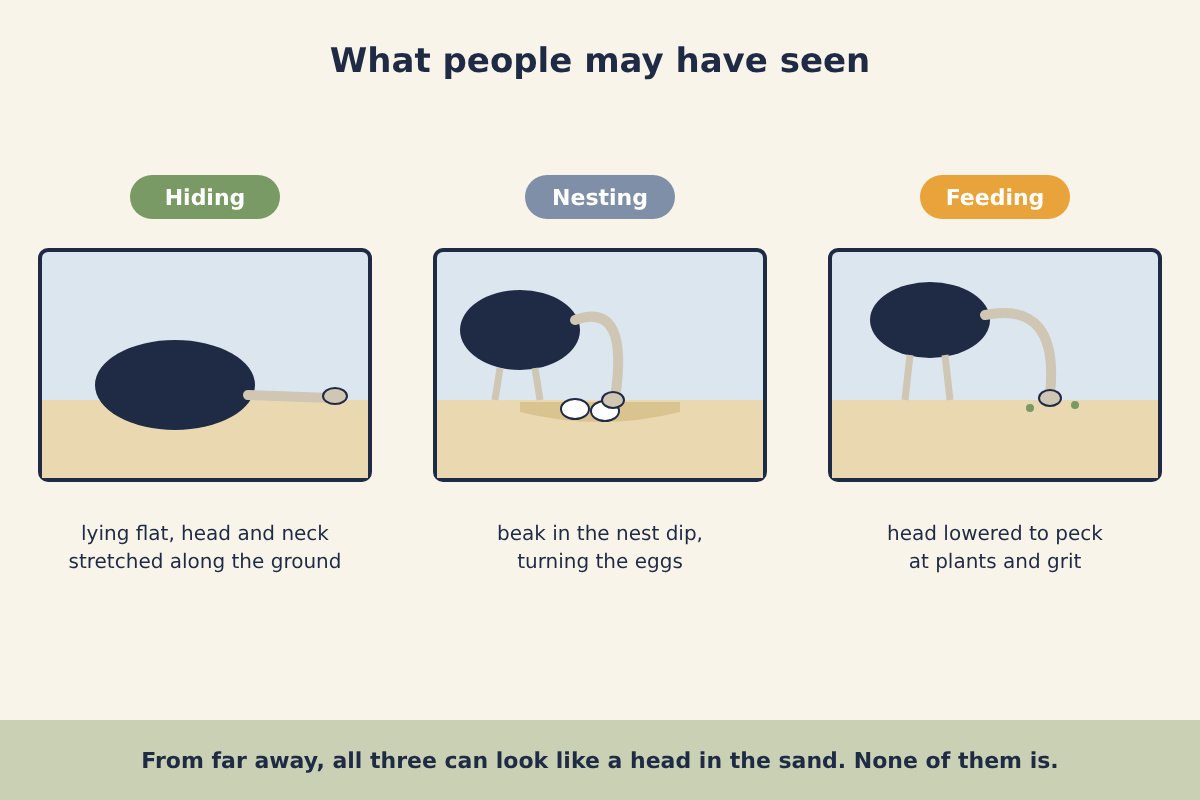
Ostriches also spend a lot of time with their heads near the ground while feeding. They peck at plants and swallow small stones and grit, which help grind up food in the gizzard. A grazing ostrich seen across a heat haze is another candidate for the head-in-the-sand picture.
Where the story began
The most commonly cited source is the Roman writer Pliny the Elder, in Book 10 of his Natural History, written in the first century AD. In the classic English translation by John Bostock and H. T. Riley, Pliny says of ostriches that "they imagine, when they have thrust their head and neck into a bush, that the whole of the body is concealed."
A bush, not sand.
Pliny was also not reporting his own observations. His Natural History gathered material from many earlier writers, so whoever first watched an ostrich and drew that conclusion is unknown. Over the centuries the bush turned into sand, and the story turned into an insult. Today "burying your head in the sand" means refusing to face a problem, and the behaviour it describes is something no ostrich has been recorded doing.
The idea of the foolish ostrich lasted because it is a good moral lesson. It gives people a vivid image for denial, and a good image is hard to give up even when the animal does not cooperate.
Why it matters that the myth is wrong
It is easy to underrate animals that look odd to us. The ostrich-as-fool story is the same kind of assumption as the idea that goldfish forget everything in three seconds: a strange-looking animal is assumed to have a simple mind, and then the behaviour gets read through that assumption. Watched carefully, a flat-lying ostrich is doing exactly what a large animal on open ground should do when it cannot run: get low, keep still and keep watching.
Colour and appearance mislead us in other ways too. Bulls do not charge at red; they react to movement. Ostriches are not hiding from danger by burying their heads; they are hiding by lying low, in plain sight.
The short answer to pass on
Ostriches do not bury their heads. They lie flat with their heads on the ground when they cannot run, and they put their heads into shallow nests to turn their eggs. The story goes back to Pliny the Elder, who described ostriches hiding their heads in a bush, not in sand.
Sources
- San Diego Zoo Wildlife Alliance, ostrich fact pages (Animals and Plants; Wildlife Explorers)
- Smithsonian's National Zoo and Conservation Biology Institute, ostrich fact page
- Cleveland Zoological Society, "Truth or Tail: Do ostriches really bury their head in the sand when scared or frightened?"
- Pliny the Elder, Natural History, Book 10, translated by John Bostock and H. T. Riley (Perseus Digital Library, Tufts University)
